You’ve done everything right. You promoted on social media, you’ve got a great prize and your questions are solid. Yet here you are on a Tuesday night, looking out at a half-full room and wondering what went wrong. With so many other ways for people to spend an evening, a “good” trivia night often isn’t enough. I’d argue the biggest lever you can pull isn’t a bigger prize. It’s your format.
Your choice comes down to a generic, all-topics quiz or a themed event. The generic one feels like the safe bet, since it’s designed not to scare anyone off. But themed trivia nights tend to win, and it’s easy to see why once you look at what a theme does for a room. One is a pleasant way to kill a Tuesday. The other is a night people put in their calendar.
Themed trivia nights tend to draw bigger, more engaged crowds and more repeat visits than generic formats. A specific theme gives you a stronger marketing hook, builds a sense of community and tends to be better for business, for venues and hosts alike.
Why Generic Trivia Is a Tough Sell Now
Trivia has grown up. A quiz night at the local pub isn’t a novelty anymore. It’s practically expected. That means you’re competing with the bar down the street and also with every streaming service, ball game and comfy couch in town. Your biggest rival isn’t another host. It’s a potential player deciding to stay home in sweatpants. Against that, generic is a real risk, and themed trivia nights are your best defense.
Many hosts default to general knowledge because they believe it has the widest appeal. The logic is, “If I have questions about sports, history, science, and pop culture, there will be something for everyone.” While well-intentioned, this approach often backfires. When you try to be for everyone, you end up being truly special to no one. Your event becomes interchangeable with a dozen others, lacking a compelling reason for someone to choose your night specifically.
The Core Difference: Generalist Appeal vs. Niche Passion

The whole debate comes down to why people show up. It’s easy to assume they come for the questions. Mostly, they don’t. They come for the experience, the community, and the feeling of being an expert. A generic format serves the first part weakly and the other two parts not at all.
The Myth of “Something for Everyone”
Here’s a typical scenario. Picture a host, let’s call her Alex, who runs a weekly general knowledge night. Turnout is decent but flat: about ten teams, mostly regulars who’d probably be at the bar anyway. The energy is fine, but nobody would call it electric. Her players enjoy it, but they aren’t telling their friends about it, and if something comes up one week, they skip it without a second thought. Alex’s event is a pleasant diversion, not a destination.
The Power of a Targeted Theme
Now picture another host, Ben, with the same flat attendance. He takes a risk. He knows from chatting with regulars that the bar is full of ’90s kids, so he announces a “90s Nostalgia” trivia night and promotes it with pictures of Blockbuster cards and Tamagotchis. On the night, people show up in flannel, and the room fills with teams he’s never seen before. Why? He offered more than a quiz. He offered a shared identity, and people came to celebrate it with like-minded folks (and to argue about whether Pogs were ever actually fun).
What Hosts Tend to See With Themed Nights
There isn’t much formal research on trivia attendance, so think of this as a pattern hosts commonly describe rather than a hard statistic. When a venue moves from a general-knowledge quiz to a rotating theme schedule, the first thing most notice is more new faces, because every theme gives people a fresh reason to show up. The bigger win comes after that: once the night becomes a recurring social highlight, regulars stick around longer and bring their friends. The best way to know what themes do for your crowd is to track it yourself, and these trivia night metrics make that easy.
Themed events are simply easier to market. Promoting “General Knowledge Trivia” is tough. The ad copy is bland, the visuals are generic, and the target audience is “everyone,” which in digital marketing terms means “no one.” Promoting “Stranger Things Trivia,” however, gives you a rich well of visuals, hashtags, and a laser-targeted audience on social media. You can reach people who have already declared their interest in the topic. You’re not trying to create demand; you’re channeling it.
| Feature | Generic Trivia | Themed Trivia | What I’d Do |
|---|---|---|---|
| Audience Draw | Broad but shallow. Attracts casuals but rarely creates die-hard fans. | Narrow but deep. Activates passionate fans who become event evangelists. | Go with themes. You’re better off with 50 superfans than 50 casual attendees. |
| Marketing Hook | Weak. “Come play trivia!” is not a compelling call to action in 2026. | Built-in. “Harry Potter Trivia Night” markets itself to a specific, identifiable group. | Use themes to make your promotional efforts targeted and effective. |
| Repeat Business | Dependent on habit. Players might come back, but loyalty is to the venue, not the event. | High. Players eagerly await the next theme they are passionate about. Creates event-specific loyalty. | A rotating theme calendar builds anticipation and turns one-off visitors into regulars. |
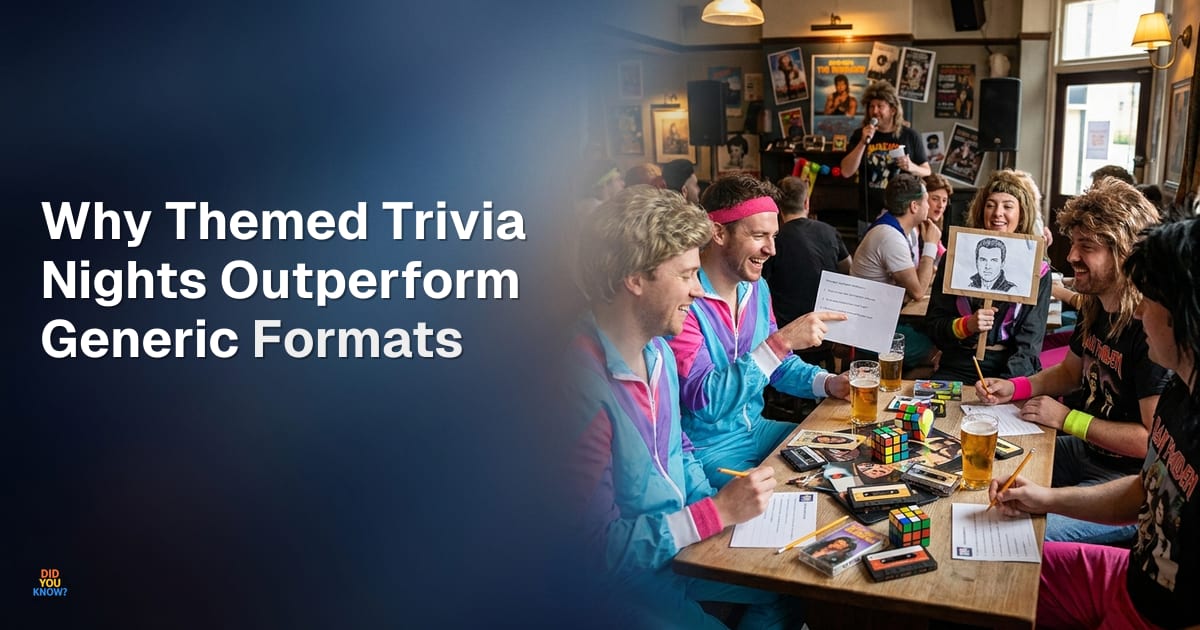
| Atmosphere | Often quiet and academic. Focus is purely on answering questions correctly. | Electric and communal. Shared passion leads to costumes, inside jokes, and high energy. | Themes turn a quiz into a full-blown event. |
| Operational Lift | Lower question-writing effort, but higher effort needed for promotion to get people in the door. | Higher question-writing effort for a specific topic, but promotion is significantly easier. | The effort trade-off is worth it. Spend time writing great niche questions, not begging people to come. |
How to Choose a Winning Theme (Without Guessing)

Switching to themed trivia nights doesn’t mean throwing darts at a board (although darts could be a fun theme). You’re looking for the sweet spot where broad appeal meets passionate fandom.
Start with Your Venue and Existing Audience
Before you look at a “Lord of the Rings” theme, look at who is already showing up. Are they millennials? Gen X? What shows do they talk about at the bar? A theme should feel authentic to the space. A quiet, cozy bookstore cafe is a poor fit for a rowdy “Rick and Morty” trivia night, but a perfect venue for “Classic Literature” or “Agatha Christie” trivia. Your first themes should be aimed squarely at the people already in the room.
Use Data, Not Just Your Gut
Your intuition is a good starting point, but data makes it better. Free tools can help you check your ideas. Look at Google Trends for your city to see what pop culture topics are spiking. Run a simple poll on your venue’s Instagram story: “What trivia theme should we do next? A) Friends B) The Office C) 80s Music.” You get direct feedback, and the poll doubles as free promotion. Social media is full of clues about what people care about, and hosts who pay attention have a real edge. For more on this, check out my guide on how social media is reshaping quiz nights.
The Rotational Theme Strategy
The hosts with the fullest rooms don’t stop at one theme. They build a calendar (here’s how to plan a themed trivia calendar). This strategy balances consistency with novelty. A great model looks like this:
- Monthly Blockbuster Theme: Once a month, go all-out on a major, high-demand theme like Marvel, Star Wars, or Taylor Swift. Promote this heavily for weeks in advance.
- Weekly Mini-Themes: For your regular weekly slots, use broader, easier-to-produce themes like “80s Movies,” “TV Theme Songs,” or “Food and Drink.”
- Audience Choice Night: Once a quarter, let the winning team from the previous month pick the theme. It builds community, and it means at least one table will be very, very invested.
This approach keeps the event from feeling stale and gives people multiple reasons to keep coming back. For more ideas on mixing things up, explore some creative trivia formats that keep people hooked.
Where Themed Trivia Is Headed
Looking ahead to 2027, I expect themes to keep getting more specific. Hyper-niche nights are already popping up, going past “Disney Trivia” to things like “Pixar Movie Quotes Trivia.” The narrower you go, the more dedicated the crowd tends to be. This also makes it easier to write trivia questions that spark debate, as true fans love to argue the finer points of their favorite subject.
The nights themselves are getting more immersive too. Think themed playlists, costumes and a drink special with a terrible pun for a name (a “Butterbeer Blast” for Harry Potter night, say). Those little touches turn a simple Q&A into an event people remember and talk about long after it’s over.
Why Themed Trivia Nights Are Worth the Effort
Choosing your format is one of the biggest decisions you’ll make as a host. A general knowledge quiz feels safe, but safe can slide into stale. Going with themes changes how you think about the whole event: it stops being a simple quiz and becomes a night built around a community.
- Generic trivia creates casuals. Themed trivia creates fans. Fans bring friends, promote your event for you and show up every single time.
- Themed trivia nights come with built-in marketing. You get a specific crowd to target and a hook that cuts through the noise.
- Start with your own crowd. Don’t guess. Ask, run polls and notice what your regulars can’t stop talking about.
- Rotate. Mix big “blockbuster” themes with lighter weekly ones so you keep the momentum without burning out your players (or yourself).
Need a starting point? My list of 10 trivia night themes that pack the room is a good place to begin, or you can browse more ideas on Did You Know?.
More theme ideas: Keep going with these 10 trivia night themes that pack the room, the 52-week trivia theme vault and how to plan a themed trivia calendar.
Frequently Asked Questions
What if I pick a theme nobody likes?
This is a common fear, but it’s manageable. Mitigate the risk by polling your audience on social media before committing. Start with universally popular themes like ’80s Movies’ or ‘Friends’ to build momentum. The risk of one underperforming night is far lower than the slow decline of a permanently generic format. Treat it as a learning experience and adjust.
How often should I run a themed night?
A highly effective model is one large, heavily promoted “blockbuster” theme per month, complemented by weekly events with lighter, broader themes (e.g., “TV Theme Songs”). This approach balances the excitement of novelty with the comfort of consistency, preventing player burnout while keeping your event calendar fresh and engaging.
Are themed nights more work to create?
They do require more focused effort upfront, particularly in question writing and targeted promotion. However, this initial investment pays significant dividends in higher turnout and audience engagement. This work becomes easier over time as you build a library of questions and understand what resonates with your specific audience.
Can a generic night ever be successful?
Of course. A truly magnetic host or a long-established event with a loyal following can absolutely succeed with a general knowledge format. However, for new events or those struggling to grow in a competitive market, switching to themes provides a real advantage in attracting and retaining a dedicated audience.
Leave a Reply