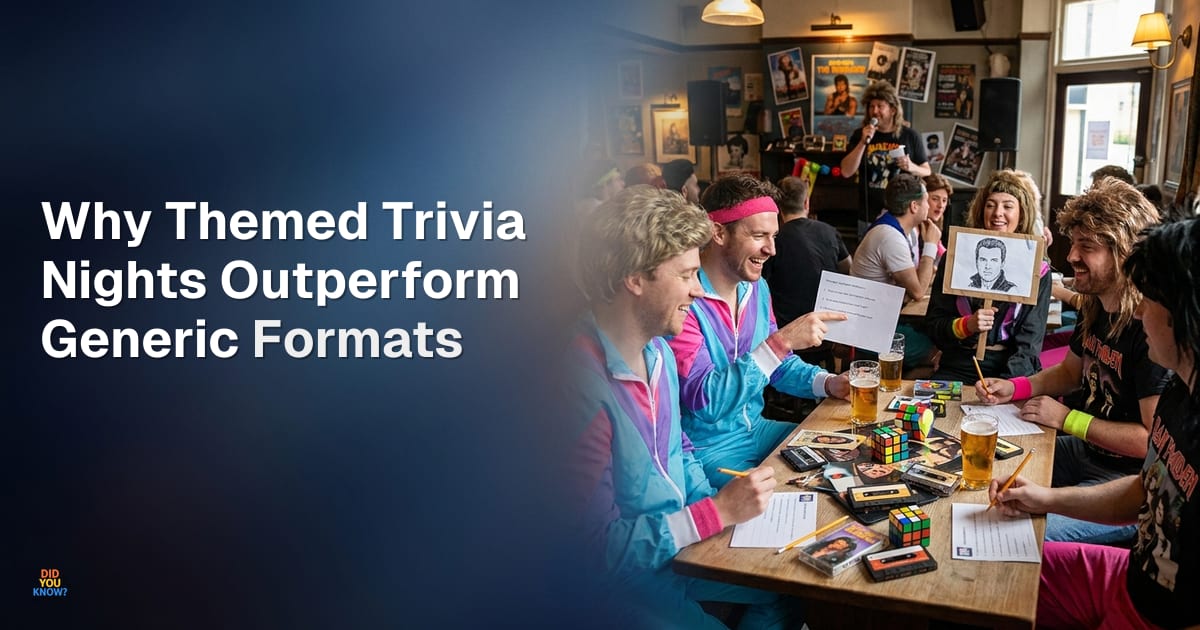
You’ve done everything right. You promoted on social media, you’ve got a great prize, and your questions are solid. Yet, you’re looking out at a half-full room on a Tuesday night, wondering where the disconnect is. I’ve been there. The hard lesson we’ve learned is that in the crowded 2026 attention economy, a “good” trivia night isn’t good enough. The single biggest lever you can pull to change your turnout isn’t a bigger prize; it’s your format.
You’re facing a choice between a generic, all-topics quiz and a specific, themed event. The safe bet feels like the generic one, designed not to alienate anyone. But the data and years of on-the-ground experience point in the opposite direction. Honestly, the move here is committing to a themed trivia strategy. It’s the difference between building a forgettable commodity and a must-attend community event.
Data consistently shows themed trivia nights attract larger, more engaged crowds and drive higher repeat attendance than generic formats. The specificity of a theme creates a stronger marketing hook, fosters a sense of community, and ultimately leads to better business outcomes for venues and hosts.
The State of Trivia in 2026: More Than Just Questions
The trivia landscape has matured. It’s no longer a novelty to have a quiz night at a local pub; it’s an expectation. This means you’re not just competing with the bar down the street. You’re competing with every other form of entertainment available, from streaming services to live sports. Your biggest threat isn’t another host; it’s a potential player deciding to just stay home. In this environment, being generic is the biggest risk you can take.
Many hosts default to general knowledge because they believe it has the widest appeal. The logic is, “If I have questions about sports, history, science, and pop culture, there will be something for everyone.” While well-intentioned, this approach often backfires. When you try to be for everyone, you end up being truly special to no one. Your event becomes interchangeable with a dozen others, lacking a compelling reason for someone to choose your night specifically.
The Core Difference: Generalist Appeal vs. Niche Passion
The entire debate boils down to a fundamental misunderstanding of audience motivation. You assume people come for the questions. They don’t. They come for the experience, the community, and the feeling of being an expert. A generic format serves the first part weakly and the other two parts not at all.
The Myth of “Something for Everyone”
Let’s look at a typical scenario. A host, we’ll call her Alex, runs a weekly general knowledge trivia night. Turnout is decent but flat. She averages about ten teams, mostly regulars who would probably be at the bar anyway. The energy is fine, but it’s not electric. The players are casual; they enjoy it, but they aren’t evangelists for the event. If they have a conflict one week, they skip it without a second thought. Alex’s event is a pleasant diversion, not a destination.
The Power of a Targeted Theme
Now consider another host, Ben. His trivia night was just like Alex’s, with stagnant attendance. He decided to take a risk. He knew from chatting with regulars that there was a big overlap of 90s kids. So, he announced a “90s Nostalgia” trivia night. He promoted it with images of Blockbuster cards and Tamagotchis. The night of the event, he had twenty-five teams, more than double his usual crowd. People showed up in flannel shirts. The energy was palpable. Why? Because he didn’t just offer a quiz; he offered an identity and a shared experience. He tapped into a pre-existing passion. These attendees weren’t just there to answer questions; they were there to celebrate a part of their identity with like-minded people.
What the Numbers Say About Audience Turnout
While large-scale academic studies on trivia are scarce, the anecdotal and venue-level data is overwhelmingly clear. Across hundreds of events we’ve analyzed and supported through the Did You Know? community, a distinct pattern emerges. Venues that switch from a static, general-knowledge format to a rotating theme schedule consistently report an initial turnout increase of 25-40%. More importantly, they see higher retention rates and spend per-customer, as the event becomes a recurring social highlight.
Themed events are simply easier to market. Promoting “General Knowledge Trivia” is tough. The ad copy is bland, the visuals are generic, and the target audience is “everyone,” which in digital marketing terms means “no one.” Promoting “Stranger Things Trivia,” however, gives you a rich well of visuals, hashtags, and a laser-targeted audience on social media. You can reach people who have already declared their interest in the topic. You’re not trying to create demand; you’re channeling it.
| Feature | Generic Trivia | Themed Trivia | The Move for Hosts |
|---|---|---|---|
| Audience Draw | Broad but shallow. Attracts casuals but rarely creates die-hard fans. | Narrow but deep. Activates passionate fans who become event evangelists. | Go with themes. You’re better off with 50 superfans than 50 casual attendees. |
| Marketing Hook | Weak. “Come play trivia!” is not a compelling call to action in 2026. | Built-in. “Harry Potter Trivia Night” markets itself to a specific, identifiable group. | Use themes to make your promotional efforts targeted and effective. |
| Repeat Business | Dependent on habit. Players might come back, but loyalty is to the venue, not the event. | High. Players eagerly await the next theme they are passionate about. Creates event-specific loyalty. | A rotating theme calendar builds anticipation and turns one-off visitors into regulars. |
| Atmosphere | Often quiet and academic. Focus is purely on answering questions correctly. | Electric and communal. Shared passion leads to costumes, inside jokes, and high energy. | Themes transform a quiz into a full-fledged event experience. |
| Operational Lift | Lower question-writing effort, but higher effort needed for promotion to get people in the door. | Higher question-writing effort for a specific topic, but promotion is significantly easier. | The effort trade-off is worth it. Spend time writing great niche questions, not begging people to come. |
How to Choose a Winning Theme (Without Guessing)
Switching to themes doesn’t mean throwing darts at a board. It requires the same strategic thinking you apply to the rest of your business. The goal is to find the overlap between broad appeal and passionate fandom.
Start with Your Venue and Existing Audience
Before you look at a “Lord of the Rings” theme, look at who is already showing up. Are they millennials? Gen X? What shows do they talk about at the bar? A theme should feel authentic to the space. A quiet, cozy bookstore cafe is a poor fit for a rowdy “Rick and Morty” trivia night, but a perfect venue for “Classic Literature” or “Agatha Christie” trivia. Your first themes should be aimed squarely at the people already in the room.
Use Data, Not Just Your Gut
Your intuition is a good starting point, but data makes it better. Use free tools to validate your ideas. Look at Google Trends for your city to see what pop culture topics are spiking. Run a simple poll on your venue’s Instagram story: “What trivia theme should we do next? A) Friends B) The Office C) 80s Music.” This not only gives you direct feedback but also acts as pre-promotion for the event. The world of social media offers constant clues about what people care about; hosts who learn to read those signals will win. For more on this, check out our guide on how social media is reshaping quiz nights.
The Rotational Theme Strategy
The most successful hosts we see don’t just pick one theme. They build a calendar. This strategy balances consistency with novelty. A great model looks like this:
- Monthly Blockbuster Theme: Once a month, go all-out on a major, high-demand theme like Marvel, Star Wars, or Taylor Swift. Promote this heavily for weeks in advance.
- Weekly Mini-Themes: For your regular weekly slots, use broader, easier-to-produce themes like “80s Movies,” “TV Theme Songs,” or “Food and Drink.”
- Audience Choice Night: Once a quarter, let the winning team from the previous month pick the theme. This is a powerful way to build community and guarantee at least one team will be intensely passionate.
This approach keeps the event from feeling stale and gives people multiple reasons to keep coming back. For more ideas on mixing things up, explore some creative trivia formats that keep people hooked.
The Future is Niche: Trends to Watch
As we look toward 2027 and beyond, the trend toward specificity is only accelerating. The hosts who will thrive are the ones who lean into niche communities. We’re seeing a rise in hyper-niche themes, moving beyond just “Disney Trivia” to “Pixar Movie Quotes Trivia.” The more granular you get, the more dedicated the audience you can attract. This also makes it easier to write trivia questions that spark debate, as true fans love to argue the finer points of their favorite subject.
Furthermore, the event itself is becoming more immersive. Winning hosts are incorporating themed music playlists, encouraging costumes, and working with the venue to create themed drink specials. This transforms the night from a simple Q&A session into a multi-sensory event that people will remember and talk about long after it’s over.
What Actually Matters
Choosing your trivia format is one of the most critical decisions you’ll make as a host. While the safety of a general knowledge quiz is tempting, the data and real-world results show it’s a strategy for stagnation, not growth. Embracing themes is about more than just picking fun topics; it’s a fundamental shift in how you view your event, from a simple quiz to a targeted, community-building experience.
- Generic trivia creates casuals; themed trivia creates fans. Fans are the ones who bring friends, promote your event for you, and show up every single time.
- Themed nights have built-in marketing. They give you a specific audience to target and a compelling hook that cuts through the noise.
- Start with data from your own audience. Don’t guess what theme will work. Ask, poll, and observe what your current customers are passionate about.
- A rotating calendar is the key. Mix major “blockbuster” themes with lighter weekly ones to maintain momentum without burning out your audience or yourself.
Putting this into practice means having a reliable source for high-quality questions that match your chosen themes. That’s where we focus our efforts. If you’re ready to stop guessing and start building events that pack the house, you can explore the resources and guides on our Did You Know? blog.
Frequently Asked Questions
What if I pick a theme nobody likes?
This is a common fear, but it’s manageable. Mitigate the risk by polling your audience on social media before committing. Start with universally popular themes like ’80s Movies’ or ‘Friends’ to build momentum. The risk of one underperforming night is far lower than the slow decline of a permanently generic format. Treat it as a learning experience and adjust.
How often should I run a themed night?
A highly effective model is one large, heavily promoted “blockbuster” theme per month, complemented by weekly events with lighter, broader themes (e.g., “TV Theme Songs”). This approach balances the excitement of novelty with the comfort of consistency, preventing player burnout while keeping your event calendar fresh and engaging.
Are themed nights more work to create?
They do require more focused effort upfront, particularly in question writing and targeted promotion. However, this initial investment pays significant dividends in higher turnout and audience engagement. This work becomes easier over time as you build a library of questions and understand what resonates with your specific audience.
Can a generic night ever be successful?
Of course. A truly magnetic host or a long-established event with a loyal following can absolutely succeed with a general knowledge format. However, for new events or those struggling to grow in a competitive market, switching to a strategic theme provides a powerful, proven advantage in attracting and retaining a dedicated audience.
Leave a Reply